
Mr. Jefferson, we the people need your help today
“Separation of church and state” refers to the constitutional principle—rooted in the First Amendment and articulated by Thomas Jefferson—that government must not establish, support, or interfere with religion, forming what Jefferson called a “wall of separation.”
The concept ensures that religious institutions and government operate independently. It derives from the Establishment Clause (“Congress shall make no law respecting an establishment of religion”) and the Free Exercise Clause (“or prohibiting the free exercise thereof”) of the First Amendment.
Historical Foundations
- Thomas Jefferson’s 1802 letter to the Danbury Baptist Association introduced the famous “wall of separation” metaphor.
- Roger Williams, founder of Rhode Island, earlier described a “hedge or wall of separation” to protect the church from state corruption.
- The principle developed in response to European religious intolerance and varied colonial practices in America.
From the Gettysburg Address.
…that this nation, under God, shall have a new birth of freedom—
and that government of the people, by the people, for the people, shall not perish from the earth.
If I could go back in time and talk to Thomas Jefferson, I would say something like this:
Hey, I understand governments have been killing people in the name of religion for some time now. Government is either killing you because you are in a particular religion or not part of a particular religion. And so, you built in certain protections.
But what you don’t see coming is that in my day, it’s not religion, it’s huge businesses.
There are no founding/foundational protections keeping the government from partnering with or persecuting large business. Government in my day is used to pick winners and losers in business, and it never picks for the people’s advantage, or maybe I should say rarely.
So please put something in the constitution that prevents government from partnering with or persecuting businesses. The government should create a healthy environment for business but always be for the people.
Now, because it’s me and I remember Paul Harvey, here is the rest of the story.
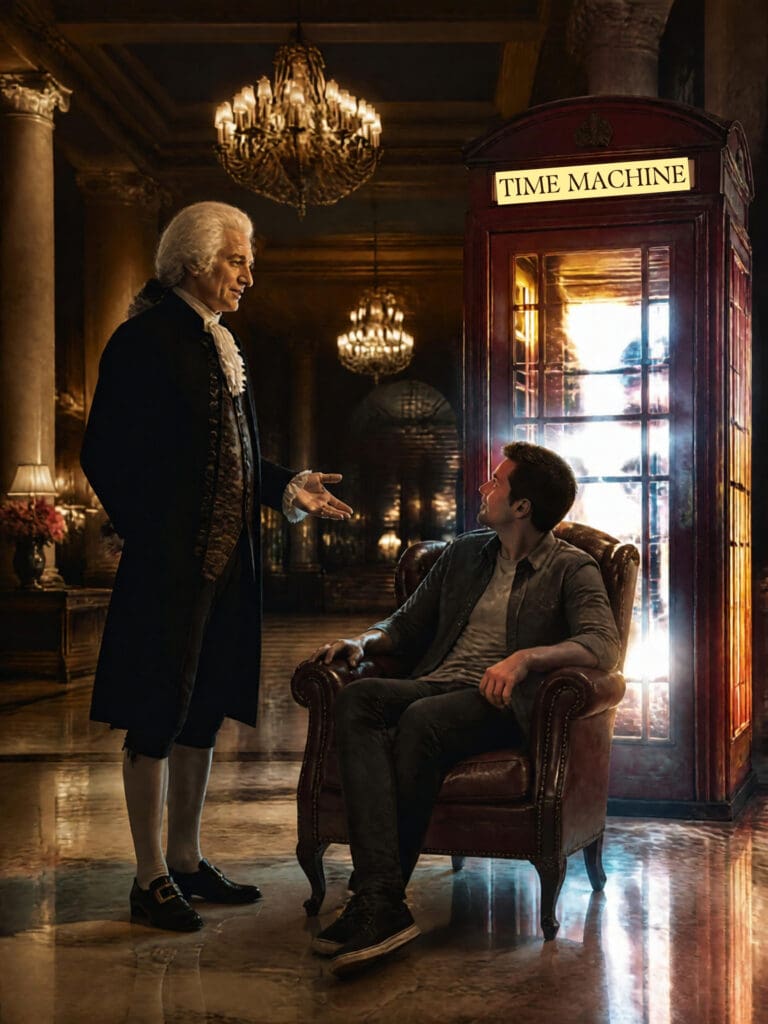
I did indeed make a Time Machine. I went back and visited Thomas Jefferson.
I took a risk, as time travelers do, and sent myself to where Thomas Jefferson was in 1787. Looking around, I see I am in an absolutely luxurious building. What is this place, I wonder out loud.
“It is the Hôtel de Langeac. Pray, sir, remain where you are. Who are you, and how came you to be within my house?” If my calculations were correct, this is Thomas Jefferson.
Thomas Jefferson eyes the Time Machine.
“Don’t be alarmed. I know it’s hard to believe, but I am a time traveler from the future,” I say calmly.
He looks at me and examines me and my clothes. He looks at the time machine and then back at me.
He sits in a fancy chair and offers a nearby one to me. I sit.
Looking around and marveling at the opulence, I say, “Hôtel de Langeac sounds French.”
Thomas Jefferson looks at me unimpressed. “You appear to be a rather ill-informed traveler through time, sir. You are, in fact, in France. I am the minister of France after all.”
He looks over at the time machine. It seems to be the only thing validating my claim of time traveler.
He looks back at me with his suspicion turning to fascination, “Tell me about the future.”
Anyone who knows me knows I like to talk. So, I happily oblige. I sit back in my fancy chair, and it welcomes me as if it wants to hear a long story.
“Well, Tom . . . is it ok if I call you Tom?” I don’t want to be rude to a founding father.
He waves away the question, standing in the way of more important discussion. I take that as consent.
“You see, I come from America in the year 2026,” I start to say but am interrupted.
Tom’s eyes widen. “So, we made it two hundred and fifty years.” His voice is hushed with amazement.
I try not to be annoyed by the interruption and continue. “Yes, the country is two hundred and fifty years old in my time. The country is strong, some would say the greatest country in the world, but it’s got some pretty big issues in my opinion. I am hoping you can help with some.
“Though I have to tell you, a lot of what is put in the Constitution gets interpreted and reinterpreted. Some are good; some are bad. Which reminds me. You might want to tighten up the 2nd Amendment. That one’s a problem.”
“That matter appears to me quite plain”, he says puzzled.
I nod, “I know, it’s just that in 2026 we have quite a standing army and militias are . . . rare. Mostly citizens use firearms for self-defense and sport.”
“To be sure,” he responds to my citizen use comment as if that were an obvious thing, but he winces at the standing army.
I see his discomfort. “Trust me, Tom, it will make more sense in 1812. But hey, that’s not really why I came.
“Imagine a world full of East India Companies. Each company possess almost as much power as that company. Together they basically control the government. You don’t create separation between these huge powerful companies and the government. To make it worse, in my opinion the Supreme Court continually affords businesses the same protections as individuals. Not totally of course, but enough to allow their influence on the government–which brings us back to you.
“We need the government to be for the people, as a future president will say. “
Thomas Jefferson shakes his head looking confused. “But the people. They can vote. They can change the Constitution to address these troubling things.”
I smiled at him. “I point to your good friend, James Maddison. He said people will pursue their own interests through democratic government. I know it’s just a quote from a bigger conversation, but in 2026 that’s a pretty common situation.
Thomas Jefferson shakes his head in a combination of amazement and confusion. Then he looks at me. “You cannot have been a very diligent student of history, sir. If it is the Constitution you wish to discuss, you should be speaking with Mr. Madison, not with me.”
That comment confuses me. “Look, I don’t have a lot of time. The charge in the time machine is draining constantly, and I need to get back to my time,” I say as I casually look over at the time machine.
To my horror, I see Benjamin Franklin stepping into it.
“Oh, what’s this marvelous contraption,” he says as he enters.
“Wait!” I cry out jumping to my feet and sending the chair tumbling out from under me.
But it was too late. With a loud zap, the time machine and Ben Franklin are gone. Well, in 1787 anyway. He’s in 2026, in my house, in the room over my garage, with my wife. She is going to be mad, I think.
Today we need a separation of Corporations and the State
You Can Not have Freedom without Participation
Discover more from MOVCAC.com
Subscribe to get the latest posts sent to your email.
