
Silence Equals Consent
From a book by William J. Federer

The fate of America and the world hangs in the balance, and you are key to turning things around. But the clock is ticking.
There are powerful truths that have been hidden for generations under religious-sounding arguments, convincing good people to be silent and let evil reign. Well-funded voices persuade citizens that it is somehow more spiritual to do nothing and let corruption spread. They teach the godly to green-light ungodly values.
Whatever happened to common sense?
It is time we ask some hard questions.
Are you aware that just as your silence gives consent to wedding vows, it gives consent to other things? It is called “the rule of tacit admission.” If you know of evil and are silent, you are an accessory to it and will share in the judgment.
Discover the unique origins of America from a perspective you may not have considered.
For example, why in Europe was there the belief that what the king believed, his kingdom had to believe? How did the theocracy of kings convince them they were divinely appointed to force their beliefs on their subjects?
Attempts were made for centuries to limit a king’s power: the Law of Freemen in St. Patrick’s 5th-century Senchurs Mor; Alfred the Great’s 9th-century Doom Book; the Charter of Liberties of 1100; the Magna Carta of 1215; the English Bill of Rights of 1689.
Where did the idea come from to simply not have a king? Who were the reformers who pioneered freedom of conscience? Who proposed a plan for people to rule themselves in a “covenant” form of government? (Did you know the word “federal” is Latin for “covenant”?)
How was the ancient Hebrew Republic, pre-King Saul, the model for the Puritans?
Are you aware that Puritans who settled Massachusetts adapted their congregational church government into their civil government?
Historian James F. Cooper, Jr., explained Puritans had “local self-government, and extensive lay participation.” In New England, every citizen was expected to participate in both church and state.
Have you heard of Connecticut founder Pastor Puritan “participation,” Thomas Hooker, whose famous sermon in 1638 articulated the concept of “government from the consent of the governed”?
Did you know kings have “subjects” who obey, but republics have “citizens” who give consent. How is Romans 13 understood differently in a self-governing republic than in a monarchy? Hint: in monarchies, subjects submit to the king; in republics, citizens ARE the king.
In a monarchy, political power flows top down through mandates; in a republic, political power flows bottom up through virtuous citizens voting in elections.
In contrast to the Puritans who participated, there were Pietists who do not participate. They emphasized a personal experience with Jesus, after which believers would be holy, withdrawing from worldly behavior, including political involvement.
How did they transition “no man can serve two masters … God and mammon” into “God and government”?
What was the “two kingdom” concept, where believers, to be holy, were expected to choose involvement in the “sphere of the church” instead of the “sphere of government”? If spiritual people withdraw from politics, who is left to be involved but the less spiritual? How did the church’s silence allow ambitious leaders to seize power and oppress the church? How did Christians in Germany allow Hitler’s government to kill Jews?
How did Pietists’ “withdrawal” differ from Puritan “participation,” where believers were active in both church and state?
How are Puritan and Pietist theological differences of the 18th century, called the Old Light—New Light controversy, still affecting pastors and churches today?
The obvious question is: Why could it not be both — a personal experience with Jesus AND a covenant plan where citizens are involved in ruling themselves?
Should church members be negligent, or should they be the salt of the earth? Is it scriptural to not care about what kind of country we are leaving to our posterity? Proverbs 13:22 states, “A good Man leaveth an inheritance to his children’s children.
Should we just wait for Jesus to come and rescue us out of this mess? Who do you think you are going to meet when you are raptured? Jesus! Do you think Jesus loves the little children? Yes! Do you think He might wonder why you did not do anything to protect them?
Moreover, even if we can’t turn the culture around, shouldn’t we at least try? Jesus warned in Mark 9:42 (NLT):
Perhaps God is giving people of faith an opportunity to show what they really believe in their hearts, through their words and actions?
History is filled with accounts of people suffering coercion and persecution by godless totalitarian governments, maligned, smeared, canceled, and crushed in hopeless situations against insurmountable odds, but then, stirred by the Spirit, little nobodies rise up, small in their own eyes, but big in faith and courage, to speak truth to power and to resist evil. Isaiah 1:17 (NASB) states:
Let’s believe it is possible to turn things around, and this is now our turn!
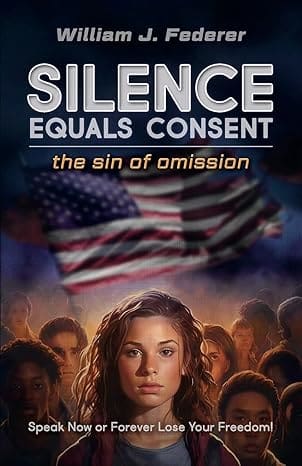
Silence Equals Consent – the sin of omission: Speak Now or Forever Lose Your Freedom
by William J Federer (Author)
Discover more from MOVCAC.com
Subscribe to get the latest posts sent to your email.
