
Remember his name: Irving Berlin
April 12th, 2026
Irving Berlin couldn’t read music and played piano in only one key. His first wife died on their honeymoon. He wrote 1,500 songs anyway—including “White Christmas,” the best-selling single ever recorded.
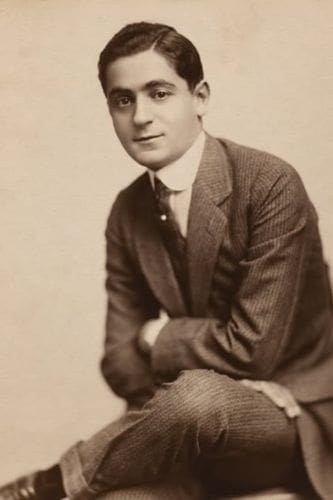
Irving Berlin was born Israel Beilin on May 11, 1888, in Tyumen, Russia. His family was Jewish, living under constant threat of pogroms—violent attacks against Jewish communities.
In 1893, when Irving was 5, his family fled to America, joining the flood of immigrants escaping persecution.
They arrived in New York and settled on the Lower East Side, one of the most crowded, poorest neighborhoods in the city. Families lived in tiny tenement apartments, working brutal hours just to survive.
Irving’s father, Moses, had been a cantor in Russia—a synagogue singer. In America, he worked odd jobs but struggled to support the family.
In 1901, Moses died.
Irving was 13 years old. He left school immediately to help support his mother and siblings.
He sold newspapers on street corners. He sang for pennies in saloons.
Irving had inherited his father’s voice—clear, strong, emotional. But saloons were rough places, filled with drunks, gamblers, and violence.
Still, Irving sang. And people noticed.
By his late teens, Irving was working as a singing waiter in Chinatown, entertaining customers while serving food. It was there he started writing his own songs—simple melodies, clever lyrics.
There was one problem: Irving couldn’t read music.
He’d never had formal training. He didn’t know musical notation. He could barely play piano—and only in F-sharp major, the black keys.
So he bought a special transposing piano with a lever that changed keys mechanically. He’d compose melodies by ear, humming and plunking out notes, then hire someone to write down the music.
This limitation never stopped him. If anything, it forced him to focus on melody and lyrics—the elements that made songs memorable.
In 1911, Irving wrote “Alexander’s Ragtime Band.”
It became a massive hit—a nationwide sensation that captured the energy of early 20th-century America. Suddenly, Irving Berlin was a famous songwriter.
His career exploded. He wrote for Broadway, for vaudeville, for Hollywood. Songs poured out of him—funny, sentimental, patriotic, romantic.
But in 1912, Irving’s personal life was shattered.
He married Dorothy Goetz, a young woman he’d fallen deeply in love with.
They honeymooned in Cuba.
While there, Dorothy contracted typhoid fever. Within days, she was dead.
Irving had been married for five months.
He was devastated. For months, he couldn’t write. Couldn’t work. Couldn’t function.
Eventually, he poured his grief into a song: “When I Lost You.”
It became a hit—a mournful ballad about love and loss that millions of people connected with.
Irving learned something: personal pain could become universal art.
In 1926, Irving fell in love again—with Ellin Mackay, a beautiful young socialite.
There was a problem: Ellin’s father, Clarence Mackay, was one of the richest men in America—a Catholic telegraph magnate who despised the idea of his daughter marrying a Jewish immigrant songwriter.
Clarence forbade the marriage. He threatened to disown Ellin if she went through with it.
Ellin married Irving anyway.
Clarence kept his promise. He cut Ellin off completely—no inheritance, no contact, no forgiveness.
The scandal was enormous. Newspapers covered it like a royal drama: the heiress and the immigrant, love versus prejudice.
Irving and Ellin didn’t care. They were married for 62 years, until Ellin’s death in 1988.
As a wedding gift, Irving wrote “Always” for Ellin—and gave her all the royalties from the song. It made her independently wealthy, a symbol of his devotion.
Throughout the 1920s and 30s, Irving became the defining voice of American music.
Broadway shows: Watch Your Step, As Thousands Cheer, Annie Get Your Gun.
Hollywood films: Top Hat, Holiday Inn, and White Christmas.
Songs: “Blue Skies,” “Puttin’ on the Ritz,” “Easter Parade,” “There’s No Business Like Show Business,” “Cheek to Cheek.”
He wrote for every occasion, every emotion. Weddings, funerals, holidays, heartbreak.
In 1938, he wrote “God Bless America” at the request of singer Kate Smith, who wanted a patriotic song for a radio broadcast.
Irving had actually written it years earlier, in 1918, but shelved it. He revised it and gave it to Smith.
It became an instant anthem—a song of hope and patriotism during the darkest days before World War II.
Irving could have made millions from “God Bless America.” Instead, he donated all the royalties—every cent—to the Boy Scouts and Girl Scouts of America.
He did the same for decades. Millions of dollars, given away, because he believed the song belonged to the country, not to him.
Then came 1942.
Irving wrote “White Christmas” for the movie Holiday Inn, starring Bing Crosby.
The song was simple—nostalgic, sentimental, longing for home and peace.
Bing Crosby recorded it. When it was released, the world was at war. American soldiers were fighting in Europe and the Pacific, far from home, dreaming of the lives they’d left behind.
“White Christmas” became their anthem.
It played on Armed Forces Radio. Soldiers requested it constantly. It reminded them of what they were fighting for—not glory or conquest, but home, family, the simple comfort of a white Christmas.
The song became the best-selling single of all time—over 50 million copies sold, a record that still stands.
Irving was reportedly uncomfortable with the song’s success. He thought it was too sentimental, too commercial. He preferred his more sophisticated work.
But “White Christmas” connected with something deep in the American soul: the longing for home, for peace, for safety.
Irving kept writing into the 1950s and 60s, but by the 1970s, he’d largely retired. He became reclusive, rarely leaving his home, rarely giving interviews.
He lived to be 101 years old, dying on September 22, 1989.
By then, he’d written an estimated 1,500 songs—more than almost any other American composer.
He’d defined American music for half a century. His songs were performed at weddings, funerals, Fourth of July celebrations, and Christmas gatherings.
And he’d done it all without being able to read music.
Irving Berlin’s story is the quintessential American immigrant success story.
He arrived as a 5-year-old refugee fleeing pogroms.
He sold newspapers at 13 to support his family.
He taught himself songwriting despite never learning to read music.
He lost his first wife on their honeymoon.
He married the woman he loved despite her father’s fury and society’s prejudice.
He gave away millions in royalties because he believed “God Bless America” belonged to America, not to him.
And he wrote the best-selling song of all time—a song that comforted soldiers in WWII, Korea, and Vietnam, that still plays every Christmas, that has become inseparable from the American experience.
Irving Berlin couldn’t read music.
He played piano in one key.
His first wife died after five months of marriage.
He wrote 1,500 songs anyway—and gave away millions in royalties.
“White Christmas.” “God Bless America.” “There’s No Business Like Show Business.” “Blue Skies.” “Puttin’ on the Ritz.”
All written by a Russian Jewish immigrant who couldn’t read a single note.
Remember his name: Irving Berlin.
The man who wrote America’s soundtrack
Discover more from MOVCAC.com
Subscribe to get the latest posts sent to your email.
