
Marietta City Council passes 3 injection well resolutions
Marietta Times
October 3, 2025
Gwen Sour
Marietta City Council on Thursday focused much of its regular meeting on drinking water protections and state-regulated injection wells, moving forward with two measures tied to oversight and potential litigation while introducing a third that urges a statewide pause on new wells.
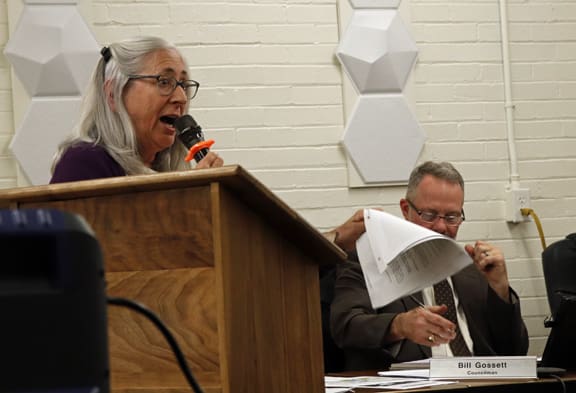
City Law Director Paul Bertram said his office has already initiated an administrative action with the Ohio Department of Natural Resources’ Oil and Gas division “to keep the City of Marietta’s options open in respect to its aquifer and its protection.”
Bertram emphasized that Resolutions 80 and 79 were written as standalone items – the former to authorize him to bring legal action, including a potential mandamus suit and the latter to establish a task force to examine injection well issues.
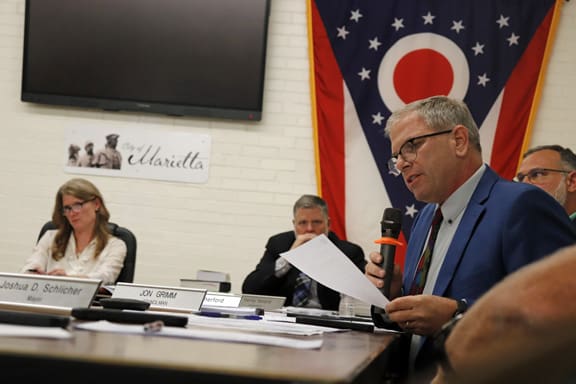
“Eighty gives me the power, and it allows me to use my discretion,” Bertram said, adding that he will ask for Resolution 79 to be amended to expand its scope to include any other proposed wells.
Betram also previewed Resolution 81, a separate measure asking the Ohio Legislature to enact a three-year moratorium on injection wells, not only in Marietta, but statewide.
“The City of Marietta does not have the ability to impose a moratorium, but the state of Ohio does,” he said.
The resolutions stemmed from concerns over ODNR’s issuance of a permit for a Class II injection well within two miles of the city’s water well field. Class II wells are used to dispose of brine and other liquid waste by injecting it deep underground into porous rock formations, sealed off from groundwater by layers of rock and casing.
The meeting drew over 80 individuals and nearly an hour of comments centered on groundwater protection, with multiple speakers critiquing ODNR’s handling of permits and inspections.
During the public forum, Marietta resident Dawn Hewitt said the city’s geology makes new wells especially risky.
“Our geology is truly like Swiss cheese,” she said, indicating a map that showed a large number of oil and gas wells across the region. “Even the highest-tech, brand-new water treatment facility can’t filter out radioactivity. … If it’s woke to care about our water, then I’m wide awake.”
Councilman Ben Rutherford said members worked in recent days to clarify the city’s legal posture after ODNR communications indicated the Stephan Well No. 1 permit was reissued multiple times under older construction rules, while operations would be governed by newer standards.
Councilman Jon Grimm told colleagues he obtained written confirmation that the drilling permit was originally issued Oct. 17, 2019, and reissued Oct. 26, 2021, with conjecture of an additional reissue likely in 2023. Grimm said that while state law allows two-year reissues when a well isn’t actively drilling, a separate administrative code limits permit duration to five years.
“All that to say I’m going to support a writ of mandamus based on that,” Grimm said.
Council members also thanked colleagues for revising Resolution 79 to address concerns and broaden the committee’s charge.
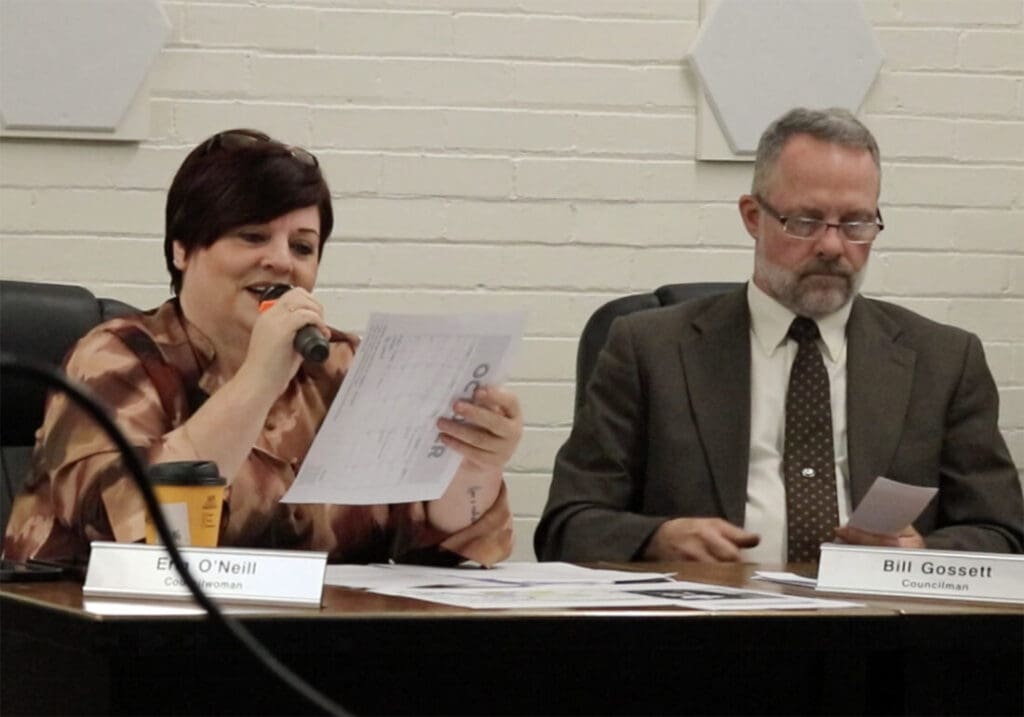
“The past couple of weeks have been a lesson in how local government is supposed to work for the citizens,” said Councilwoman Erin O’Neill. “My actions here tonight reflect nothing other than my desire to speak out for my constituents who don’t otherwise have a voice to fight against powerful government entities … from here on out, Marietta will no longer stand by and allow ourselves to become a dumping ground for other people’s waste.”
Washington County Commissioner James Booth, in a letter read into the record, backed the pause on injection wells.
“This is not the time to look at money for economic development if our water is not safe or in jeopardy,” he said. “I am in favor and support Marietta City Council’s initiative to have a moratorium on more injection wells until such time that any and all concerns are addressed factually.”
Resolution 79 saw the amendment expanding its scope beyond Stephan Well No. 1 approved by a unanimous vote, and the resolution itself was adopted unanimously. For Resolution 81, council added an emergency clause, then suspended the second and third readings before adopting it, all on unanimous votes. Council suspended the third reading of Resolution 80 unanimously and adopted the measure with support from all members except Rutherford.
Rutherford stated his hesitation on immediate action stemmed from “conflicting directions” and a desire to proceed with more information.
“As we get more data and we get more information, those things become easier decisions,” he said.
What the measures do
* Resolution 79 – Creates an Injection Well Task Force under Marietta City Council’s Water, Sewer & Sanitation Committee, now expected to review all proposed Class I and Class II wells affecting Marietta, not just the Stephan Well No. 1.
* Resolution 80 – Authorizes the law director to pursue legal remedies – including a writ of mandamus – to ensure current safety standards are applied and to challenge administrative actions that could endanger the city’s aquifer.
* Resolution 81 – Urges the Ohio General Assembly to enact a three-year statewide moratorium on injection wells to allow further study and updated oversight.
Washington County Commissioner Booth’s statement to be read into the record on October 2nd.
President Vessels,
I am writing to you today due to the fact that I am out of town and unable to attend the Council meeting on Thursday. I have an opinion and want to make sure that my position is clear.
Statement:
I, James Booth, want to make my position clear on the issue of injection wells in Washington County, Ohio. First of all, I am not a Petroleum Engineer, Hydrologist, or certified in any area that pertains to Oil and Gas Production. I do understand that the oil and gas production in our area is very important to the economic development of our area, the State of Ohio, and the United States of America. I am in full support of this initiative. Unfortunately due to the process of fracking, there is waste that must be addressed as to how it is disposed of.
This process injects this waste back into the ground at a deep distance. This is supposed to keep our aquifers safe from the contamination of the waste material. It has been stated by many sources that there is no way that our aquifers could ever see this happen. I have real concerns, and here is why.
Approximately 4 years ago, the Board of County Commissioners started the “Washington County Safe Water Project”. This was then, and still now, a listing of needs in our county for the safe production of water for the residents. We communicated this to many state and federal representatives. They were excited to see our initiative and forethought for the safety of our area. I myself live in Lowell, Ohio which did have the worst of the county. The iron and manganese content was so high that at one point the village had to hand out bottled water for consumption. Some residents were not able to even bathe in it due to medical conditions. That has now been fixed and safe water is now in Lowell.
With the Washington County Safe Water Project in mind, I have been closely monitoring the issue of injection wells in our area. It concerns me greatly that this area could be taking an extreme amount of brine water used in the injection process. I only want to look at facts. I am not interested in just saying “we do not need any more injection wells” or any other negative talk about oil and gas. Recently I was presented evidence of a possible aquifer contamination. The Williamstown water well (same aquifer) showed C6 and C7 in a recent reading of a required test. How did this happen? Is the Marietta well next? Are we ready to throw caution to the wind without making sure that we keep our water safe? I say no!
This is not the time to look at money for economic development if our water is not safe or in jeopardy. This is the time to pause, follow the evidence and facts, to make sure that our aquifer stays safe. I personally am not interested in taking brine from 2 or 3 other states to inject into our area. Why would they not keep it in their state? Why would they spend the money on trucking, rail, and river to transport it here? In my experience in the trucking business, this makes no sense to me due to the fact that transportation costs are extremely high.
In closing I am in favor and support Marietta City Council’s initiative to have a moratorium on more injection wells until such time that any and all concerns are addressed factually. Also, I ask that ODNR, OEPA, and the State of Ohio consider seriously the damage that could happen to our area. Are we in so much of a hurry to collect fees to the state that caution is thrown out the window?
I thank you for your time and wish you the best on the ordinances.
James Booth
Washington County Commission
223 Putnam Street
Marietta, Ohio 45750
Discover more from MOVCAC.com
Subscribe to get the latest posts sent to your email.
