
ODNR using old rules on new injection wells tied to state senator
Athens Independent
By Dani Kington & Eric Boll
September 18, 2025
Tighter rules for new fracking injection wells weren’t applied to multiple applications from a company formerly headed by an Ohio senator who chairs the Energy Committee.
MARIETTA, Ohio — After issues with underground migration of toxic fracking waste, the state has established new rules to protect human health and the environment. Those rules haven’t been applied to multiple applications for new southeast Ohio injection wells from a company with ties to an Ohio senator.
The new rules followed a 2019 incident that upended the Ohio Department of Natural Resources’ assumptions about underground geology. The underground migration of toxic fracking waste is especially pronounced throughout southeast Ohio.
Environmental activists in the region warned of the problem for years: Fracking waste injected underground at high pressures might eventually crack or otherwise find its way through the geologic formations meant to contain it, threatening water supplies, health, and the environment.
In 2019, fracking waste was found in oil and gas production wells that were more than five miles from a Washington County injection well.
Among other contaminants, this waste (known as brine) often contains PFAS – chemicals linked to birth defects and increased risk of cancer – as well as radioactive waste that can remain in the environment for thousands of years and cause bone, liver and breast cancers.
The ODNR Division of Oil and Gas Resources Management “did not [previously] contemplate that injected fluid could migrate in the manner described” by their investigation into the brine migration observed in 2019, according to a 2023 division order.
ODNR did not find evidence of drinking water contamination in that investigation, though the migration did disrupt oil and gas production wells. The company at issue modified its injection well and later resumed operations.
The division later suspended several other injection wells in southeast Ohio, including four in Athens County and two in Noble County. The division found that each of these wells posed a risk to human health and the environment, while also disrupting oil and gas production.
As a result of underground migration issues, ODNR stopped issuing permits for new injection wells into the Ohio Shale, the geologic layer into which all the problem wells injected waste.
The division also began considering additional regulatory action after the Washington County incident.
The division rewrote in full the administrative rules that govern the Class II injection wells used to store fracking waste underground. The new rules went into effect Jan. 13, 2022.
Since then, however, the division has approved permits for three new injection wells under the old rules, including one in Trumbull County that has since expired and two in Washington County. It’s using old rules for at least two additional wells under consideration in the region, too.
The division says the old rules apply because the initial applications for the wells were submitted prior to the rule change.
Four of the five wells approved or under consideration are located in southeast Ohio — and are owned by DeepRock Disposal Solutions, a company with ties to Ohio Senator Brian Chavez (R-30).
Until last year, Chavez served as DeepRock’s CEO. He still maintains ties to the company. Signal Ohio reported that Chavez’s spouse organized a DeepRock representative to appear at a Marietta City Council meeting.
In Washington County, new wells have been met with fierce opposition from a broad coalition of local governments, residents, oil and gas producers and state representatives. Former Democratic Athens County Commissioner and environmental activist Roxanne Groff described their fight as a “Washington County uprising.”
Division says wells are safe, references rules that aren’t being followed
State Rep. Kevin Ritter (R-94) and ODNR Division of Oil and Gas Resources Management Chief Eric Vendel discussed concerns over new Washington County injection wells in a July email exchange that the Independent obtained through a public records request.
Assuring Ritter that the injection wells are safe, Vendel referenced the new rules, which he said have “strengthened permitting, construction, and operational requirements.”
However, the current rules in place to regulate Class II wells were not followed for the new wells that prompted concerns from Washington County residents.
The two injection wells approved this year in Washington County, both owned by DeepRock, could not have been approved under the current rules. They would have been considered too close to existing oil and gas production wells.
Specifically, the new injection wells operate in the same geologic layer as existing production wells, not owned by DeepRock, within a two-mile radius, according to the Independent’s review of available oil and gas well data.
In previous instances of brine migration, such production wells have been disrupted by nearby fracking waste injection wells and have provided pathways for fracking waste to travel upward, posing risk to human health and the environment.
DeepRock has had a history of issues with brine migration. Brine from one of its Noble County wells caused an environmental disaster in 2021, affecting multiple oil and gas production wells. DeepRock did not have to pay for the cleanup; the state initially paid the $1.3 million required and then sued the production company to recoup the cost.
Additionally, Washington County oil and gas producers allege that fracking waste stored by DeepRock is leaking underground and allege the brine is interfering with oil and gas production and poses a threat to drinking water.
ODNR issued a permit for DeepRock’s Stephan No. 1 well on Aug. 28. DeepRock submitted its application for a reissue permit to drill the well in December 2021, before the new rules regulating injection wells went into effect.
“The Stephan #1 well application to construct will be evaluated under the rules in effect at the time the application was submitted,” Karina Cheung, spokesperson for ODNR, told the Independent in an email. “Similarly, any future potential permit to inject would be evaluated under the rules in the Ohio Administrative Code during the time it was submitted.”
Activists, oil and gas companies and public officials alike decried the division’s decision to consider the well under the old permitting rules. Marietta City Council argued in a lengthy legal complaint to the division that its approach to permitting under outdated rules flies in the face of established case law.
Chueng said the division would “review Marietta City Council’s comments as part of the standard review process.” She also said the division had received feedback from the public regarding the well and that the division “read and considered each citizen’s concern.”
Those concerns evidently didn’t affect the division’s decision, however. It approved the Stephan No. 1 well under the old rules anyway.
Neither of the DeepRock wells permitted this year are yet operational, according to ODNR data. Meanwhile, the division is still weighing two additional DeepRock Disposal Solutions injection well applications under the old rules, one in Washington County and one in Noble County.
DeepRock drags its feet
Nearly four years elapsed from DeepRock’s application for a reissue permit to drill the Stephan No. 1 well in 2021 and ODNR’s approval in August, an uncommonly long period.
The division has approved 18 new fracking waste injection well permits since 2021, according to ODNR data available online. On average, those permits were approved within 10 months of the application date. Some applications were approved in under a month.
Much of the approval timeline comes down to how quickly a company takes necessary steps to advance the process after it submits its initial permit application. For multiple DeepRock applications, ODNR extended deadlines for the company to meet necessary requirements.
In two cases, DeepRock’s initial permits to drill expired and the division considered reissue permits. It granted the Stephan No. 1 well’s reissue permit, and the other, for a Noble County well, remains pending.
DeepRock sent in the Noble County reissue application in January 2024 — well after the new rules were established. However, the division is continuing to evaluate it under the old rules. “Your original application was received prior to the new rules becoming effective,” the division told DeepRock in a May 6 email.
Groff said she thinks the company is receiving special treatment, perhaps due to its ties to Chavez, who represents Meigs, Athens, Morgan, Washington, Noble, Monroe, Belmont, Guernsey, Harrison and Jefferson counties in the Ohio Senate. Chavez chairs the Ohio Senate’s Energy Committee.
Chavez has used his platform as a state senator to speak against those targeting DeepRock, describing environmental nonprofit Buckeye Environmental Network as a “radical far left” and “California funded” organization.
Chavez did not respond to the Independent’s requests for comment for this story.
Chueng said the division notified DeepRock about its rule changes just as it notified all interested parties per Ohio law.
The fate of DeepRock’s pending Washington County application is unclear: DeepRock applied to the Ohio Environmental Protection Agency to inject non-hazardous waste into the well, and a DeepRock contractor told the Independent that the company no longer intends to use the well for fracking waste injection.
However, the division told the Independent that it was still evaluating DeepRock’s application to use the well for fracking waste, as of Aug. 21.
Washington County governments react to well concerns
Putnam Community Water, which serves 950 households in Washington County, objected to the Stephan No. 1 well, expressing concerns about the water supply.
“We see a great potential in these injection wells causing significant harm to not only to our water supply but also the other community water systems that serve our Washington County Residents,” said Jay Huck, the Putnam Community Water manager, in an email to Chavez and ODNR representatives that the Independent obtained through a public records request.
Marietta City Council’s objection to the Stephan No. 1 well cited similar concerns about the numerous injection wells already operating and under consideration in Washington County.
“These wells, individually and as a group, create an unacceptable risk to the public health and safety of the 32,000 citizens served by four nearby and separately operated aquifers,” Marietta City Council wrote in its complaint to the division.
That complaint caused a conflict during a meeting of the Washington County Republican Party.
According to a report from Signal Ohio based on leaked audio also reviewed by the Independent, Marietta City Council President Susan Vessels got into an argument with Chavez about the danger posed by fracking waste.
During the argument, Chavez accused the Marietta City Council of “outrageous” behavior, claimed that Buckeye Environmental Network was hosting “fake town halls,” and said that Saudi Arabia and China are funding political opposition to natural gas.
In response, Vessels accused Chavez of a conflict of interest due to his connections to the oil and gas industry. Vessels also disputed Chavez’s claim that injection wells could safely contain brine.
Chavez and Vessels aren’t the only government figures having tense conversations over the new wells. In the July emails between Ritter and Vendel, Ritter expressed dissatisfaction with how Vendel and ODNR have been managing the proposed wells.
Ritter told Vendel that representatives of the Warren Water Board reported to him that Vendel had expressed concern about the laws regulating wells. In response to this confusion, Ritter wrote:
“If you do have reservations with current safety law, someone with authority needs to know. The public and the people in the industry need to know. If you believe the public’s fears are unfounded then you need to say that publicly.
I am tired of getting thrown under the bus. For six years as County Commissioner I took calls from the public while ODNR sat in their offices. That is not a strategy designed to win public trust. Your agency is responsible for the oversight of these wells, not me.
I’d like to know if you believe the wells are safe, and if they are, what EXACTLY is your proactive plan to allay the fears of the public. My sole concern is the welfare of the residents of the 94th District. We all need to know whether your EXPERTS believe these wells are safe.”
In his emailed response to Ritter, Vendel denied telling the Warren Water Board that he had concerns about the laws regulating wells and stated that the Division of Oil and Gas is “proactive in addressing potential issues with injection well operations.”
Vendel pointed to the current injection well rules as an example of the division’s work to ensure safety in his email to Ritter. He did not address the fact that those new rules were not applied to the most recent injection well approved in Washington County, and are not being applied to multiple pending DeepRock applications in the region.
Ritter later told the Independent in a phone interview that his frustration with ODNR’s communication around Washington County injection wells goes back to his time as a Washington County Commissioner.
“The board of commissioners made a formal request for a public meeting, and that was held at St. Ambrose church,” Ritter said. “I was deeply disappointed, because the first thing that came out in that meeting was a statement that said, ‘We’re not here to answer questions. We’re here to listen and we’ll answer those questions on our website at a later date.’ As you can imagine, that was very frustrating to the crowd.”
Ritter said ODNR has “experts that can take people’s questions, give them reliable information. Reliable information is the key to calming public fear, because ODNR has largely been absent on this issue. We do have significant public fear, and I lay that right at their feet.”
Washington County residents and activists share their stories
Local residents gathered April 26 in the Warren High School auditorium for one of two town halls about new Washington County injection wells, hosted by Buckeye Environmental Network. The town hall began with prepared remarks by local oil producers, retired scientists, environmental activists and community leaders.
Neither Chavez nor Ritter were present, although both were invited to attend. Warren Township Trustee Joe Vickers, who emceed the event, highlighted their absences with two empty chairs.
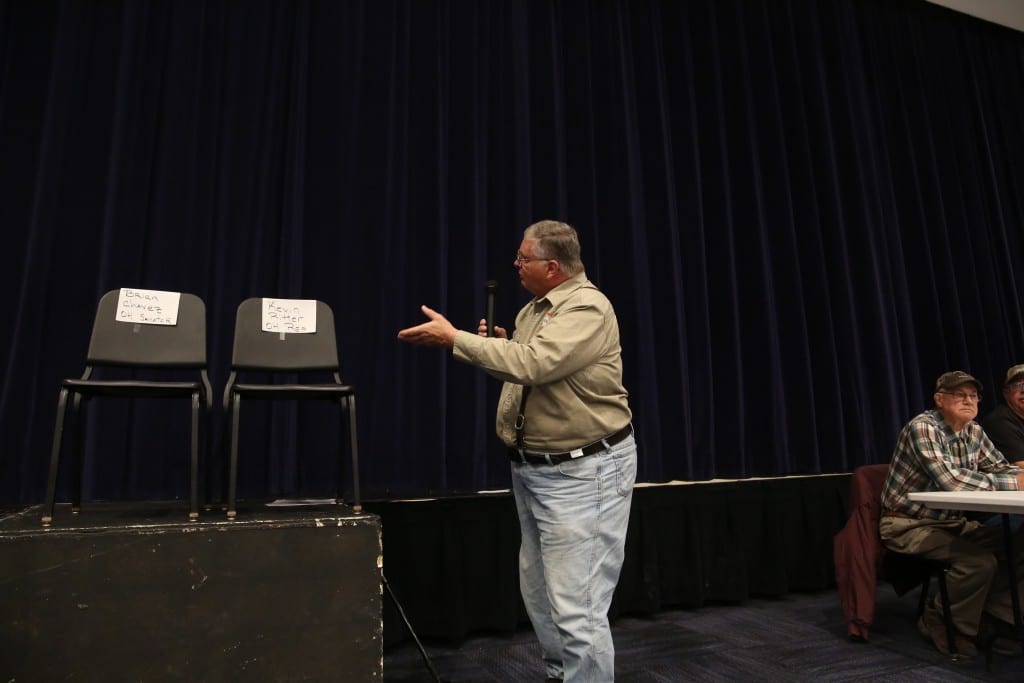
In his email to Vendel, Ritter said he had an unspecified prior commitment and that the organizers’ decision to highlight his absence with the chair caused him to decline future invites to the group’s town halls.
Both town halls featured a number of local figures who oppose how ODNR and the state government are managing fracking waste in the region.
Bob Wilson, a local natural gas professional who owns dozens of wells in Washington County, was among them. In 2022, he and local farmer and natural gas well owner Bob Lane filed suit against several injection well companies, including DeepRock. The case is currently under review by the Ohio Supreme Court.
At the first town hall April 26, Wilson said that ODNR and other state officials did not respond to his 2019 complaints until former state representative Jay Edwards contacted ODNR on his and Lane’s behalf. Edwards got Wilson and Lane a meeting, Wilson said, but ODNR continued to deny that fracking waste caused issues at his wells until its formal investigation of Washington County brine migration.
Lane and Wilson have continued to voice concerns about fracking waste contamination in the years since. Lane submitted an official complaint on behalf of numerous producers in 2024. The public records obtained by the Independent did not show any official follow-ups by the division on that complaint.
Wenda Sheard, an attorney and Ritter’s Democratic opponent in the last election, spoke at the April 26 town hall about the health risks posed by fracking waste. In an article published by the Yale School of Medicine, Nicole Deziel, a researcher on environmental contaminants, stated that numerous studies have linked fracking and fracking waste to “low birth weight, preterm births, congenital anomalies, asthma, and even childhood cancers.”
Residents at the April 26 town hall also noted increased seismic activity in the region. Earlier this year, Washington County experienced two earthquakes in one week, as reported by WOWK. Academic studies in Oklahoma and Texas have linked increased seismic activity to fracking and injection wells.
At another event hosted May 19 by Buckeye Environmental Network and the Warren Water Association, water association trustee Steven Hutchinson said he was concerned about long-term damage to the aquifer. These concerns were shaped in part by the region’s experience with PFAS contamination of the Ohio River from DuPont’s Washington Works near Parkersburg, West Virginia.
“We have four wells that are in an aquifer along the Muskingum River not far from here, and could that brine water [in]filtrate them? Absolutely,” Hutchinson said. “That’s our biggest concern.”
State Rep. Tristan Rader (D-13) attended the May 19 meeting to hear from concerned residents about issues related to fracking waste, injection wells and carbon capture, after residents talked about their experiences with injection wells at a statehouse hearing on carbon capture.
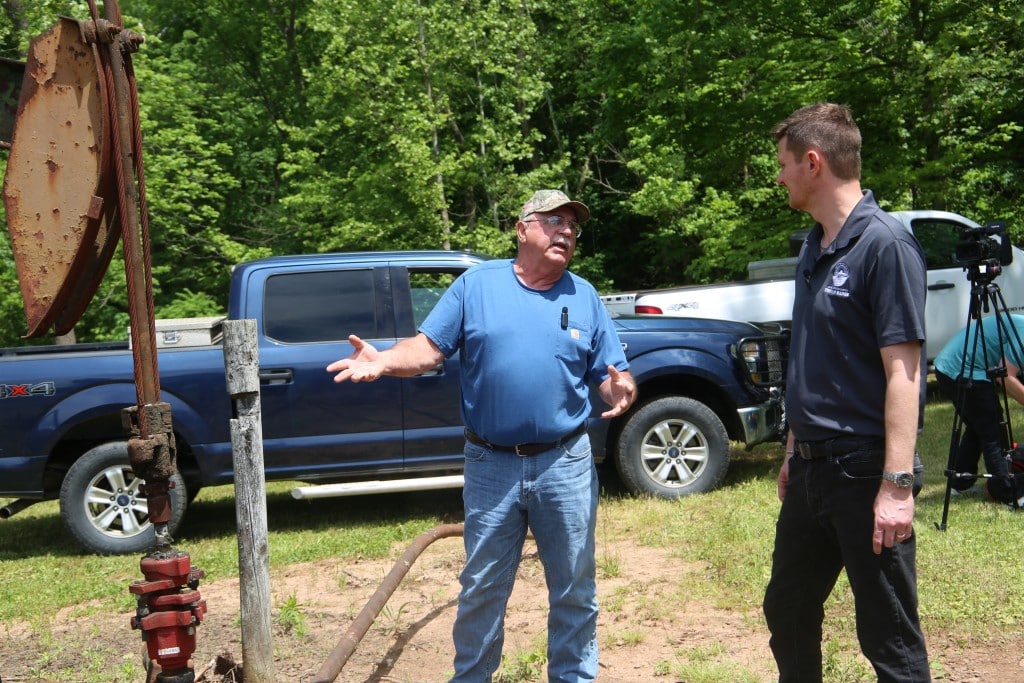
Since his visit, Rader introduced House Bill 399, which would prohibit removal of oil and gas under Lake Erie or Ohio state parks. Rader also recently introduced House Bill 439 which, if passed, would prohibit the use of fracking waste on roads to melt ice and snow.
Ritter told the Independent that he would support HB 439, calling it “common sense legislation.”

Discover more from MOVCAC.com
Subscribe to get the latest posts sent to your email.
